Annapurna Circuit Trek – 29 Days – 29 Days
- Max Elevation: 5416 m
- Meals: Breakfast, Lunch, and Dinner with a cup of tea / coffee
- Transportation Kathmandu to Besishahar and Nayapul to Pokhara and Pokhara to Kathmandu by local public transports
- Group Size: 2 Min Pax
- Starts at: Kathmandu
- Ends at: Kathmandu
- Trip Route:
Annapurna Region
- Best Season: Spring (March to May) and Autumn (September to November)
Trip Highlights
- Glorious views of Annapurna I ( 8,091m), Manaslu (8,163m) and Dhaulagiri ( 8,167m)
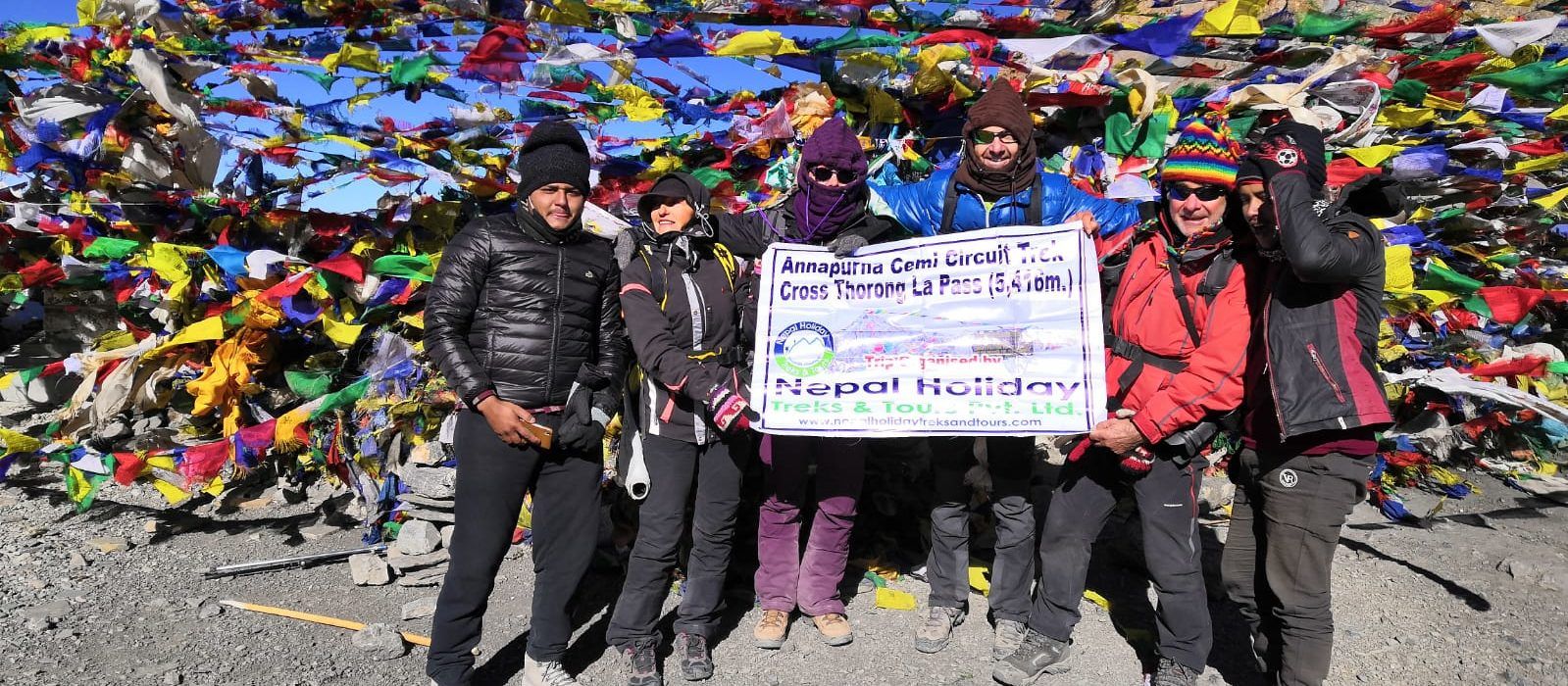
- Crossing the legendary Thorong La Pass (5,416m) – the point of the trek
- Relaxing in the Natural hot springs at Tatopani
- Visiting the sacred Muktinath Temple – holy site for Hindus and Buddhists
- Exploring the mystical Mustang region with red cliffs and ancient cave dwellings
- Walking through centuries – old Buddhists monasteries and prayer flag lines trails
- Experience the rich culture of Gurung, Thakali and Manangi communities
- Magical sunrise views from Poon Hill (3,193m) over the Annapurna and Dhaulagiri ranges
- Tasting famous Marpha apple products – pie, juice and local apple brandy
- Diverse landscapes from subtropical forests to high – altitude alpine deserts
- Encounter traditional villages and deep dramatic gorges along the trail
- Reaching Annapurna Base camp (4,130m)
Trip Information
Overview
Detailed Itinerary
Day 1: Drive from Kathmandu (1,400m) to Besisahar (760m)
Your adventure begins with a picturesque drive from Kathmandu, Nepal’s vibrant capital, to the tiny town of Besisahar that signifies the beginning of the trek. This drive is between 7 to 8 hours, and you will travel through colorful countryside, terraced rice paddies, traditional villages and rolling green hills. The road follows the scenic Marsyangdi River valley with views of the Himalayan foothills, as well as some glimpses of local life along the way. This first driving portion is a portion of your acclimatization to the altitude and serves as a mental warm-up to the hike.
Day 2: Trek - Besisahar to Bhulbule (840m)
After breakfast, you start your trek northerly up the Marsyangdi River valley. The route is fairly easy downhill and along the river past terraced fields, forests and tiny hamlets. You cross a number of suspension bridges, all providing great views of the white foams of water beneath and the surrounding mountains. The walk is not too strenuous, so it is a great way to get started with trekking. In the late afternoon, you reach Bhulbule, a tranquil village to take in the crisp mountain breeze, unwind and get yourself ready for what lies ahead.
Day 3: Bhulbule to Bahun Danda (1,310m)
Today’s trek is a gentle climb as you head upstream along the Marsyangdi River valley on the trail. Terraced fields, forests and pretty villages make up the rural landscape. You will feel the change in altitude and vegetation as you ascend. The trail then ascends to Bahun Danda, a tranquil hill village with stunning vistas of the surrounding hills and valleys. It’s an ideal place to kick back, watch the sunset and take in the breathtaking landscape, tantalizing your taste buds for what lies ahead.
Day 4: Trek - Bahun Danda to Jagat (1,300m)
Today’s route brings you even closer to the Himalayas. The path traverses more suspension bridges across the Marsyangdi River and enters pine, bamboo and rhododendron forests. Farming and traditional life of village farmer, that you meet are local villagers, you talk with them and see life. It’s a moderately difficult walk, with some steep gradients, but the magnificent mountain views and the feeling of wilderness make it worthwhile. You reach Jagat (1,300 m), a traditional village, with mud houses, monasteries and a warm, inviting atmosphere, where you can immerse yourself in the local culture.
Day 5: Trek - Jagat to Dharapani (1,860m)
As you make your way onward, you bid the green river valley farewell and begin your climb to the village of Dharapani. The trail meanders among terraced fields, small streams and suspension bridges, all the while revealing breathtaking views of massive peaks such as Annapurna II, Annapurna III. Dharapani is a busy village and the gateway to the Manang region and a wonderful place to stop, rest, water and acclimatize for the higher altitudes. You might also get to visit local monasteries and see traditional village life in Nepal.
Day 6: Dharapani to Chame (2,670m)
Today’s route takes you up through a combination of pine woodlands and boulder-strewn ground. As you gain elevation, the scenery becomes more alpine, with breathtaking mountain views increasingly appearing. Chame is the district capital town of Manang and it has hot springs that serve as a good means for relax tired muscles. The small town boasts breathtaking views of Annapurna, Lamjung Himal and many other peaks in the vicinity. The mood is tranquil and you can soak in the local hot springs or visit the tiny monasteries that dot the town.
Day 7: Trek - Chame to Pisang (3,330m)
The path from Chame to Pisang offers some of the best mountain views on the trek. You cross rugged terrain following the river valley, but with views of Annapurna II, Annapurna III and Pisang Peak. The path is harder as you climb through thick forest, then across alpine meadows. Arrive at Pisang, a scenic village with ancient stone houses and a monastery, a fine place to get further acclimatized with great mountain views.
Day 8: Trek - Pisang to Manang via Ngwal (3,540m)
This is a big day as you make your way to Manang, a major acclimatization stop. The trail runs through the village of Ngwal, which is dotted with ancient caves and monasteries. As you go up, you find yourself in a stark, dry environment with breathtaking mountain landscapes. The views of Annapurna and Gangapurna are stunning. Arrive at Manang (3,540m) where you are now in a very high altitude environment and need to start acclimatizing for the days ahead.
Day 9: Rest Day at Manang (Acclimatization Day)
Today is rest and acclimatization day. You need to allow your body some time to get used to the higher elevation instead of going straight up to avoid getting altitude sickness. You can visit the monasteries of Manang, go to local markets or trek to nearby viewpoints such as Gangapurna Lake or Ice Lake. This third day enables a safer and more pleasurable trek for you as you get ready to cross even higher passes.
Day 10: Trek - Manang to Khangsar (3,750m)
After a day of rest and acclimatization, you hike from Manang to Khangsar, a tiny mountain settlement at 3,750 meters. The trail ascends through alpine meadows, farmed villages and wild terrain. Khangsar gives tourists the chance to see traditional local Himalayan life, in stone houses and the camps of yak herders. The views are spellbinding and the towering mountains encircle you.
Day 11: Trek - Khangsar to Tilicho Base Camp (4,150m)
Today’s hike will lead you on a rough route to the Tilicho Base Camp at 4150m. The trail crosses lofty mountain passes, rocky terrain and isolated wild places. The dramatic scenery includes snow-capped mountains and deep gorges. This is also the area from where the trek to Tilicho Lake (one of highest lakes in the world) starts.
Day 12: Early morning hike to Tilicho Lake (4,919m) and trek down to Shree Kharka (4,060m)
In the morning you trek to Tilicho Lake (4,919m) which is renowned for its high-altitude environment and surreal beauty. The trek provides breathtaking views of surrounding glaciers and peaks. After the lake visit, you drop Wild, a small village at 4060 m, rugged and challenging terrain to Shree Kharka, where you can rest and acclimatize further.
Day 13: Trek - Shree Kharka to Ledar (4,200m)
Our walk today descends from Shree Kharka into a harsher, high-alpine landscape. The trail meanders along rocky trails, yak herders’ camps, and alpine meadows. Ledar is a comfortable stopping point before the demanding crossing of Thorong La Pass. The mountains were so tall and the valleys are so expansive, that the scenery never stopped to cease to amaze.
Day 14: Trek - Ledar to Thorung Phedi / Thorung High Camp (4.925m)
It is a vital day as you make your way up Ledar to Thorong Phedi or the High Camp at 4,925 m. The path is steep and arduous, so take it slow and acclimate peoperly. The region teems with trekkers getting ready to traverse the Thorong La Pass and you will enjoy spectacular mountain views all the way.
Day 15: Trek - Thorung Phedi over Thorung La Pass (5,416m) to Muktinath (3,800m)
This will be the most difficult day of your trek. Early in the day, you climb the world-renowned Thorong La Pass at 5,416 m, one of the highest passes in the Himalayas. The climb is steep, and the altitude is high, so it is a physical challenge. The sense of achievement just makes the vistas higher up all the better and you can enjoy beautiful views of surrounding peaks once you reach the top. After you cross the pass, you descend into the holy town of Muktinath, known for its temples and spiritual importance. It’s a day of triumph and awe.
Day 16: Trek - Muktinath to Kagbeni (2,804m)
Today’s walk is a gentler descent across semi-desert terrain. You go through the old village of Kagbeni (Tibetan architecture, monasteries, the Kali Gandaki River). The views are spectacular, red cliffs and mountain views, and the spiritual feeling of Muktinath still lingers.
Day 17: Trek - Kagbeni to Jomsom (2,720m)
You follow the Kali Gandaki River on foot to Jomsom, a busy town surrounded by apple orchards and bustling local trade. The countryside is bare and harsh, with sights of the Dhaulagiri and Nilgiri mountains. Jomsom is like the gateway to the Mustang region and after days of isolation it is a bustling center to relax.
Day 18: Trek - Jomsom to Marpha (2,670m)
Today’s trek is an easy walk along the valley of the river, through some beautiful countryside with views of Nilgiri and Dhaulagiri. You reach Marpha, a dashing town known for its apple brandy, cider and native Thakali way of life. The combination of whitewashed houses and apple orchards is very picturesque and friendly, great for a stay and wander.
Day 19: Drive - Marpha to Tatopani (1,190m)
Today, continue your scenic drive southward through a mixture of scenery rolling hills, small villages, terraced fields, etc. toward Tatopani, leaving the mountains behind. It is famous for natural hot springs, Tatopani is a great place to recharge your batteries after long day walks. They said hot springs have healing power, so what better place to relax.
Day 20: Trek - Tatopani to Ghorepani (2,850m)
The path rises gently in green forests, passing small rivers and rice terraces on the way to Ghorepani. The village is known for its stunning mountain views and colorful local culture. This climb is a great chance to continue acclimatizing and getting ready for the end of the trek.
Day 21: Trek - Ghorepani to Tadapani (2,630m) via Poon hill (3,210m)
Before the sun rises, you make your way up to Poon Hill, one of the most popular vantage points in the Himalayas, for a stunning sunrise over the Annapurna and Dhaulagiri ranges. After enjoying the panoramic views you descend through rich forests to Tadapani, surrounded by serenely mountain scenery and the sounds of nature.
Day 22: Trek - Tadapani to Chhomrong (2,170m)
The trail today leads downhill through thick rhododendron and bamboo forests, with views of Annapurna South and Machhapuchhre (Fishtail) at close range. You get to Chhomrong, a wonderful village with the traditional stone houses, terraced fields and calm surroundings. It’s a good place to relax and soak up the views of the mountains.
Day 23: Trek - Chhomrong to Bamboo (2,310m)
This journey is a steep drop down half-forested hillsides to the village of Bamboo at the bottom of the Annapurna Sanctuary. This is the nature of the here and they utilize this as a launching pad for journeys into the Annapurna Base Camp zone. One can relish the cool shade of the forest and the calm ambiance.
Day 24: Trek - Bamboo to Deurali (3,230m)
You hike through gradually increasing forested trails to Deurali, a picturesque mountain pass and rest stop with spectacular mountain views. The terrain turns rough and alpine as you climb higher, with crisp mountain air and towering peaks all around you.
Day 25: Trek - Deurali to Annapurna Base Camp (ABC) (4,130m)
Today is a highlight of the trip as you trek into the Annapurna Sanctuary to the Annapurna Base Camp at 4,130 meters. The path meanders through breathtaking scenery with towering snow-capped peaks such as Annapurna I, Machhapuchhre and Hiunchuli surrounding you. The ambience is stunning and you can visit the base camp, take photos and enjoy the extraordinary mountain views.
Day 26: Trek - ABC to Bamboo (2,310m)
After a memorable stay at ABC, you make your way back down to Bamboo, taking in a different view of the mountains and terrain. The downhill is beautiful and refreshing, you will have time to think about what it’s like to be encircled by some of the world’s tallest mountains.
Day 27: Trek - Bamboo to Jhinu Danda (1,780m)
Today we follow the forested trail down more to Jhinu Danda, known for its natural hot springs. A great place to unwind tired muscles, bath in warm water and relax in tranquil surroundings. The lush greenery and mountain views are great to relax with.
Day 28: Trek - Jhinu Danda to Kimche (1,640m) then drive to Pokhara (822m)
Your trek comes to an end as you walk to Kimche and then by road to Pokhara, a charming lakeside town renowned for breathtaking mountain panoramas, boating, and lively culture. Here you can unwind, browse the lakeside markets and contemplate your amazing adventure through the Himalayas.
Day 29: Drive - Pokhara to Kathmandu (1,400m)
This is the last day of your trek. Your adventure concludes with a scenic drive or flight back to Kathmandu. You will carry memories of towering mountains, remote villages, and personal achievement, concluding an unforgettable trek through the Himalayas.
Price Includes
- Three times three meals a day- Breakfast, Lunch, Dinner and 3 cups of tea/Coffee a day during the trek.
- Accommodation in teahouse/ lodge during the trek.
- Fresh fruits after dinner every night as dessert during the trek.
- Annapurna conservation area permit and TIMS Card (Trekkers information management system).
- Kathmandu to Besishare by local transportation, Kimche to Pokhara by local transport, and Return Back to Kathmandu by tourist Bus.
- 1 Night Tourist standard hotel in Pokhara.
- You will be under observation with a pulse oximeter to have your oxygen levels and heart rate measured twice a day during the trek. This is to catch the signs of Altitude Mountain Sickness (AMS) early, thus making trekking safer.
- An experienced, helpful, knowledgeable, friendly, English speaking well trained, government license holder Trekking Guide with all his salary, food, Drinks, accommodation, equipment, transport, and insurance.
- Normal First aids kit box.
- Arrangement of Emergency Helicopter service (paid by your travel insurance company).
- Nepal Holiday T-shirt & Trekking Map.
Price Does not Include
- International airfare and visa fees.
- Airport pickup and Drop service
- Lunch and dinner in Kathmandu and Pokhara.
- any accommodation in Kathmandu.
- Personal expenses of bar and beverage bills, Wi-Fi, hot shower, bottle of water, extra porters, laundry, or any other things that are not mentioned by the company.
- Your trekking gear and extra nights in a certain destination.
- Your travel insurance, which should include the emergency rescue.
- Tips for your guide and porters, which is compulsory.
- Extra expenses due to any event such as strikes, weather conditions, or flight delays.